
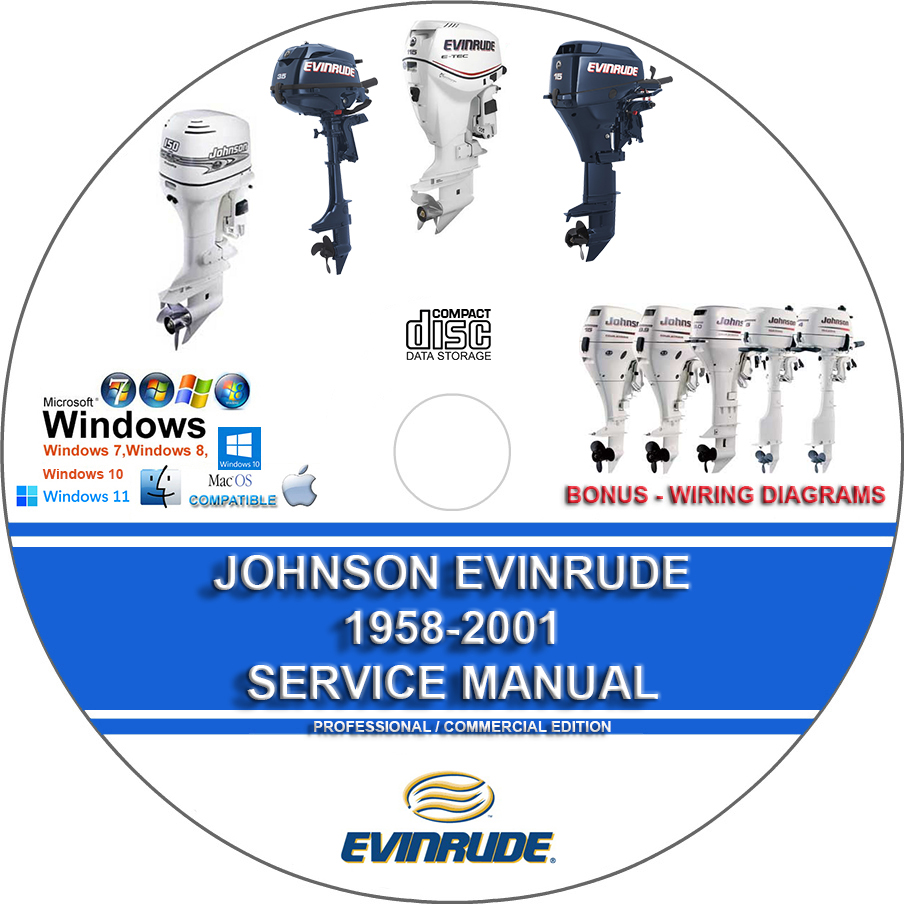
Johnson Evinrude Outboard 1958 1959 1960 1961 1962 1963 1964 1965 1966 1967 1-300 HP Factory Service Repair Manual
Price range: $42.00 through $51.00
Johnson Evinrude Outboard 1958 1959 1960 1961 1962 1963 1964 1965 1966 1967 1-300 HP Factory Service Repair Manual
You can download this or I can ship it to you.
Loaded with Hi Resolution illustrations, instructions, photos, and diagrams, complete to service and repair your JOHNSON EVINRUDE.
Johnson Evinrude Outboard 1958 1959 1960 1961 1962 1963 1964 1965 1966 1967 1-300 HP Factory Service Repair Manual
1958-2001
1.5 – 300 Horsepower
Loaded with illustrations, instructions, photos, and diagrams, complete to service and repair your JOHNSON EVINRUDE.
” Works on any computer, laptop, smartphone, iPad, iPhone, or tablet. “
Years Included:
1958 1959 1960 1961 1962 1963 1964 1965 1966 1967 1968 1969 1970 1971 1972 1973 1974 1975 1976 1977 1978 1979 1980 1981 1982 1983 1984 1985 1986 1987 1988 1989 1990 1991 1992 1993 1994 1995 1996 1997 1998 1999 2000 2001
Includes:
2 & 4 Stroke
1Cyl – 8Cyl
And Jet Drives
All Systems
All Models
Manual Covers:
- General maintenance
- Engine overhaul/Service and repair
- Controls, Final Drive
- Exhaust systems
- Ignition and starting/Charging
- Fuel systems
- Cooling and Lubrication
- Specifications and adjustments
- Transmission overhaul/repair
- Very Detailed Script With Diagrams Specs. & Lots Of Photos. Print Out One Page Or A Whole Reference. All Systems Right Down To The Wire Colors
This manual is the same as the manual used by workshops. Service Manual contains detailed instructions and step by step diagrams for all workshop procedures.
Language: English
Format: PDF – Indexed and Searchable
COMPATIBLE WITH ALL WINDOWS & MAC COMPUTERS
(WINDOWS 11, WINDOWS 10, WINDOWS 8, ETC.)
Windows/Mac/Tablet/Phone Friendly
- Factory Information – Accurate repair procedures, specifications, service information tailored to your vehicle.
- Permanent Ownership – No subscriptions, recurring fees, or expiration dates. Buy it once and keep it forever.
- No Software Required – Works with any standard PDF reader on Windows, Mac, smartphones, and tablets.
- Flexible Storage Options – Save your manual to a USB drive, CD, DVD, cloud storage, Dropbox, computer, or mobile device.
- Print-Friendly Format – Print the entire manual or only the pages needed for a specific repair.
- Portable & Convenient – Compact PDF files make storage and access simple from virtually any device.
- Models: 1.5, 3, 4, 5, 5.5, 6, 7.5, 9.5, 10, 15, and 18 HP.
- Technology: Traditional two-cylinder, two-stroke cross-flow designs utilizing points-and-condenser ignitions. The low-profile 9.5 HP model (introduced in 1964) became incredibly popular for its ultra-compact design, positioning the powerhead deep inside the lower cowling wrap to save space on small fishing boats.
- Models: 28, 30, 33, 35, and 40 HP.
- Technology: Large-displacement, slow-turning twin-cylinder engines. These were the workhorses of mid-size runabouts. They relied on single dual-throat carburetors and were offered in standard manual rope-start configurations or upgraded electric-start versions.
- Models: 50, 60, 75, 80, 85, 90, and 100 HP.
- Technology: In 1958, OMC shocked the marine industry by releasing the world’s first production V4 outboard engine (the Johnson Super Sea-Horse and Evinrude Starflite). These large 90-degree V4 blocks brought smooth, heavy-duty automotive-style power to the water, handling the weight of expanding family cabin cruisers and early water-ski boats.
- The Two-Line Pressure Tank System (Pre-1960): Models built up to 1959 lacked an internal fuel pump. Instead, they used a pressurized “two-line” fuel tank. The engine pumped air into the metal tank to force gasoline out into the carburetor. By 1960, OMC modernized the lineup by adding standard vacuum-operated fuel pumps, transitioning to safe, modern single-line fuel tanks.
- Selectric / Electramatic Shifting (1962+): In 1962, OMC introduced an automated push-button gear shift system. Instead of using a physical mechanical lever, the dash buttons sent electrical current down wires inside the midsection to activate powerful electromagnetic spring clutches inside the lower gearcase.
- Transition to 50:1 Fuel Mix (1964): Up until 1963, these outboards required a heavy oil mixture—typically 24:1 (one pint of oil to three gallons of gas). Thanks to improved crankshaft needle bearings, OMC officially shifted to the modern 50:1 lean oil ratio in 1964 for cleaner operation.
- Magneto Ignitions & Cracked Coils: This entire era relies on a mechanical magneto system under the flywheel containing dual ignition coils, breaker points, and condensers. The original factory coils from this decade were wrapped in a shiny green or black plastic that systematically cracks with age, allowing moisture to enter and shorting out the spark. Upgrading to modern, epoxy-molded replacement coils fixes this permanently.
- The Danger of Selectric Gearcases: The push-button electric shift gearcases require highly specialized maintenance. They strictly require Type C (Premium Blend) marine gear oil. If you put standard, heavy-viscosity gear lube into a Selectric lower unit, the oil’s thickness will prevent the magnetic coils from clamping, causing the transmission to slip or get permanently stuck in forward gear.
- Crankcase Fuel Recirculation Lines: Many mid-range and V4 models from this era feature tiny, external brass or rubber lines running along the side of the engine block. These lines scavenge raw, unburnt fuel puddled in the bottom of the crankcase and pump it back into the top cylinders. If these small lines rot, plug with old oil, or crack, the engine will idle incredibly rough and sneeze through the carburetors.
- Carbon Buildup from Modern Fuel: These classic cross-flow engines were designed to burn leaded gasoline. When running modern unleaded fuel, carbon builds up rapidly on the piston crowns and behind the piston rings. Running a high-quality marine carbon-cleaner additive through the fuel tank annually is vital to prevent the rings from sticking and scoring the cylinder walls.
| Medium | USB Flash Drive, DVD, Download |
|---|
Related products
Johnson Evinrude
Johnson Evinrude Outboard 1998 1999 2000 2001 1-300 HP Factory Service Repair Manual
Watercrafts/Boats
Watercrafts/Boats
MERCURY MARINER OUTBOARD 1965 – 2000 ALL MODELS FACTORY SERVICE REPAIR WORKSHOP MANUAL
Watercrafts/Boats
Johnson Evinrude
Watercrafts/Boats