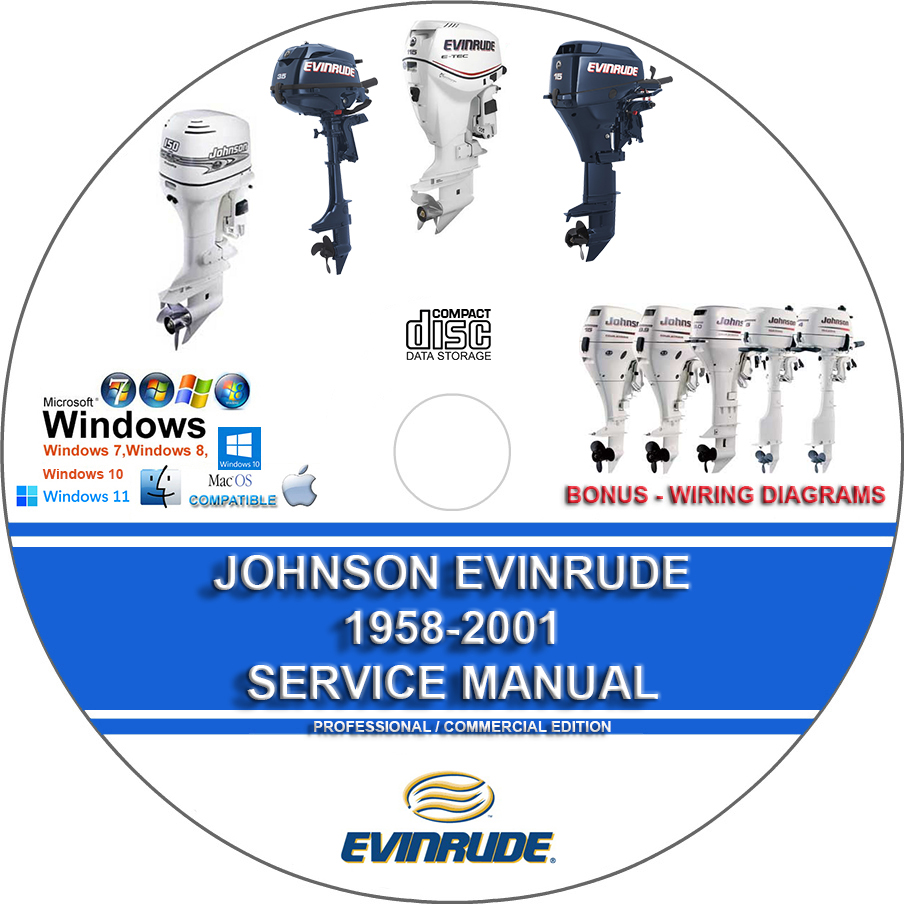
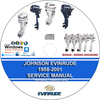
Johnson Evinrude Outboard 1998 1999 2000 2001 1-300 HP Factory Service Repair Manual
Price range: $42.00 through $51.00
Johnson Evinrude Outboard 1998 1999 2000 2001 1-300 HP Factory Service Repair Manual
You can download this or I can ship it to you.
Loaded with Hi Resolution illustrations, instructions, photos, and diagrams, complete to service and repair your JOHNSON EVINRUDE.
Johnson Evinrude Outboard 1998 1999 2000 2001 1-300 HP Factory Service Repair Manual
1958-2001
1.5 – 300 Horsepower
Loaded with illustrations, instructions, photos, and diagrams, complete to service and repair your JOHNSON EVINRUDE.
” Works on any computer, laptop, smartphone, iPad, iPhone, or tablet. “
Years Included:
1958 1959 1960 1961 1962 1963 1964 1965 1966 1967 1968 1969 1970 1971 1972 1973 1974 1975 1976 1977 1978 1979 1980 1981 1982 1983 1984 1985 1986 1987 1988 1989 1990 1991 1992 1993 1994 1995 1996 1997 1998 1999 2000 2001
Includes:
2 & 4 Stroke
1Cyl – 8Cyl
And Jet Drives
All Systems
All Models
Manual Covers:
- General maintenance
- Engine overhaul/Service and repair
- Controls, Final Drive
- Exhaust systems
- Ignition and starting/Charging
- Fuel systems
- Cooling and Lubrication
- Specifications and adjustments
- Transmission overhaul/repair
- Very Detailed Script With Diagrams Specs. & Lots Of Photos. Print Out One Page Or A Whole Reference. All Systems Right Down To The Wire Colors
This manual is the same as the manual used by workshops. Service Manual contains detailed instructions and step by step diagrams for all workshop procedures.
Language: English
Format: PDF – Indexed and Searchable
COMPATIBLE WITH ALL WINDOWS & MAC COMPUTERS
(WINDOWS 11, WINDOWS 10, WINDOWS 8, ETC.)
Windows/Mac/Tablet/Phone Friendly
- Factory Information – Accurate repair procedures, specifications, service information tailored to your vehicle.
- Permanent Ownership – No subscriptions, recurring fees, or expiration dates. Buy it once and keep it forever.
- No Software Required – Works with any standard PDF reader on Windows, Mac, smartphones, and tablets.
- Flexible Storage Options – Save your manual to a USB drive, CD, DVD, cloud storage, Dropbox, computer, or mobile device.
- Print-Friendly Format – Print the entire manual or only the pages needed for a specific repair.
- Portable & Convenient – Compact PDF files make storage and access simple from virtually any device.
- Johnson (Carbureted & EFI 2-Strokes): Positioned as the reliable, traditional choice. Most Johnson models from 1 to 250 HP used tried-and-true carburetors or electronic fuel injection (EFI). They were smoky and less fuel-efficient but mechanically bulletproof and highly affordable.
- Evinrude (FICHT Direct Injection): Positioned as the high-tech, eco-friendly premier brand. These engines used FICHT Direct Fuel Injection to blast fuel straight into the cylinder at ultra-high pressure. This technology cut fuel use by 35% and drastically reduced smoke to meet strict incoming EPA emissions laws.
- Models: 2 hp, 3 hp, 4 hp, 6 hp, 8 hp, 9.9 hp, 15 hp, 25 hp, 30 hp.
- Technology: Purely carbureted, twin-cylinder or single-cylinder traditional two-strokes (predominantly branded as Johnson). Highly valued today for their lightweight portability and simplicity. [1]
- Models: 3-cylinder and V4 blocks (40 hp, 50 hp, 70 hp, 90 hp, 115 hp).
- Technology: Available as standard Johnson carbureted models or Evinrude FICHT models. The V4 90 and 115 HP FICHT models from 1999–2001 were highly successful and proved far more reliable than their larger V6 counterparts.
- Models: Large 60-degree and 90-degree V6 powerheads (135 hp, 150 hp, 175 hp, 200 hp, 225 hp, 250 hp).
- Technology: Standard Johnson V6s (like the legendary Ocean Runner series) remained robust workhorses. However, the 1998–1999 Evinrude 150 HP and 175 HP FICHT V6 engines suffered severe, systemic powerhead failures due to early software and soot-buildup issues, cementing a controversial legacy for early FICHT models.
- The “FICHT Ram Injection” Fix (2001+): When BRP bought the brands in 2001, they completely re-engineered the FICHT system, rebranding it as “FICHT Ram Injection.” If you are looking at an Evinrude from this era, a 2001 BRP-built model is vastly superior and more reliable than a 1998–1999 OMC-built model.
- Strict Oil Requirements: FICHT direct-injection outboards are highly sensitive to oil quality. Running cheap, TC-W3 conventional oil will quickly plug the fuel injectors and carbon-lock the piston rings. These engines strictly require premium synthetic or semi-synthetic injection oil (such as XD-50 or XD-100).
- Carbon De-Gapping: Because early direct-injection engines ran lean at idle, carbon would bake onto the spark plug tips. Mechanics must use a carbon-dissolving additive (like Engine Tuner) annually and strictly “index” the spark plugs (facing the plug gap directly toward the fuel injector) for the engine to run smoothly.
- The VRO (Variable Ratio Oiling) System: On carbureted Johnson models, the VRO pump automatically mixes gas and oil. If a used boat has been sitting, checking the oil side of the pump for cracking or air leaks is vital to avoid leaning out the cylinders.
| Medium | USB Flash Drive, DVD, Download |
|---|
Related products
Watercrafts/Boats
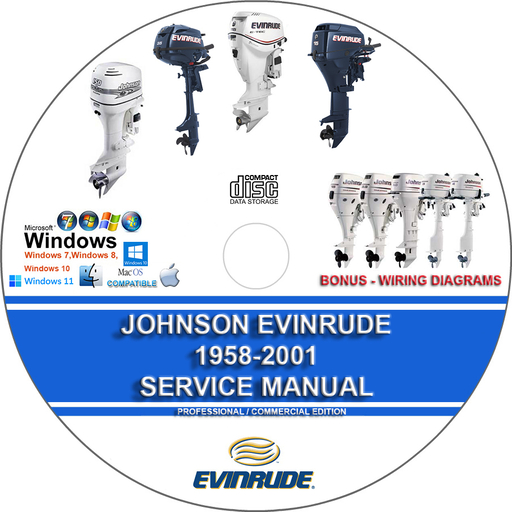
Johnson Evinrude
Watercrafts/Boats
Watercrafts/Boats
Mercury Two stroke 2.2 2.5 3 3.3 6 8 9.9 10 15 Mariner Factory Service Repair Manual + Wirings