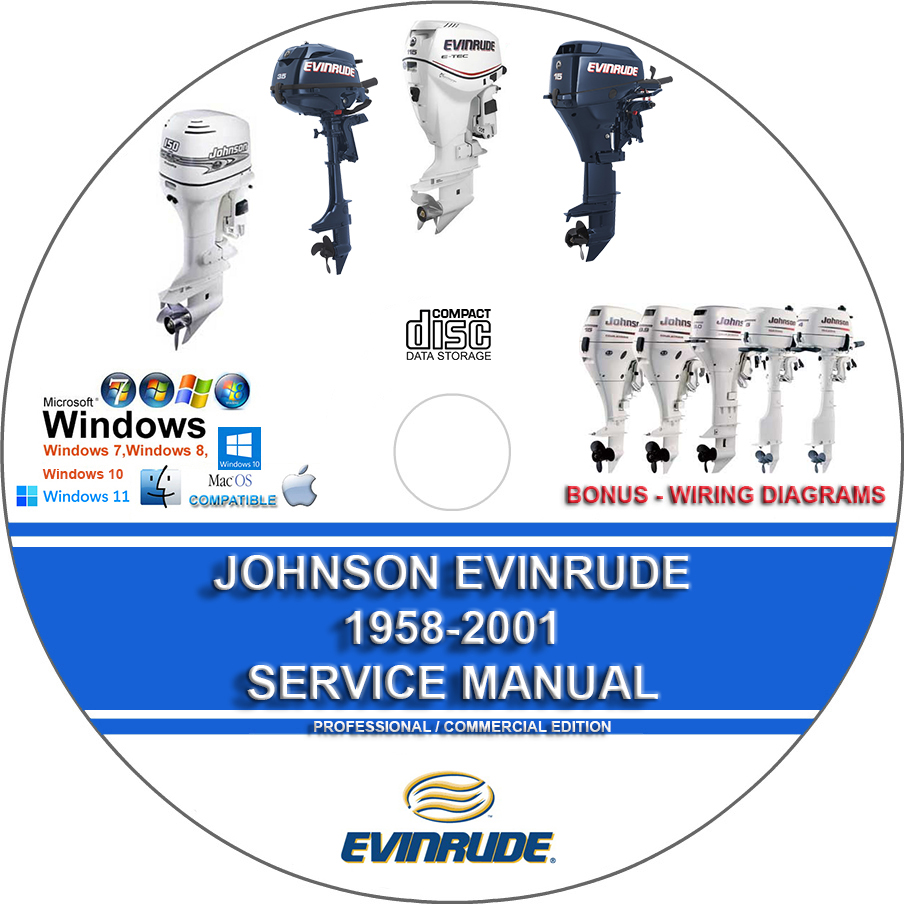
Johnson Evinrude Outboard 1988 1989 1990 1991 1992 1993 1994 1995 1996 1997 1-300 HP Factory Service Repair Manual
Price range: $42.00 through $51.00
Johnson Evinrude Outboard 1988 1989 1990 1991 1992 1993 1994 1995 1996 1997 1-300 HP Factory Service Repair Manual
You can download this or I can ship it to you.
Loaded with Hi Resolution illustrations, instructions, photos, and diagrams, complete to service and repair your JOHNSON EVINRUDE.
Johnson Evinrude Outboard 1988 1989 1990 1991 1992 1993 1994 1995 1996 1997 1-300 HP Factory Service Repair Manual
1958-2001
1.5 – 300 Horsepower
Loaded with illustrations, instructions, photos, and diagrams, complete to service and repair your JOHNSON EVINRUDE.
” Works on any computer, laptop, smartphone, iPad, iPhone, or tablet. “
Years Included: 1958 1959 1960 1961 1962 1963 1964 1965 1966 1967 1968 1969 1970 1971 1972 1973 1974 1975 1976 1977 1978 1979 1980 1981 1982 1983 1984 1985 1986 1987 1988 1989 1990 1991 1992 1993 1994 1995 1996 1997 1998 1999 2000 2001
Includes:
2 & 4 Stroke
1Cyl – 8Cyl
And Jet Drives
All Systems
All Models
Manual Covers:
- General maintenance
- Engine overhaul/Service and repair
- Controls, Final Drive
- Exhaust systems
- Ignition and starting/Charging
- Fuel systems
- Cooling and Lubrication
- Specifications and adjustments
- Transmission overhaul/repair
- Very Detailed Script With Diagrams Specs. & Lots Of Photos. Print Out One Page Or A Whole Reference. All Systems Right Down To The Wire Colors
This manual is the same as the manual used by workshops. Service Manual contains detailed instructions and step by step diagrams for all workshop procedures.
Language: English
Format: PDF – Indexed and Searchable
COMPATIBLE WITH ALL WINDOWS & MAC COMPUTERS
(WINDOWS 11, WINDOWS 10, WINDOWS 8, ETC.)
Windows/Mac/Tablet/Phone Friendly
- Factory Information – Accurate repair procedures, specifications, service information tailored to your vehicle.
- Permanent Ownership – No subscriptions, recurring fees, or expiration dates. Buy it once and keep it forever.
- No Software Required – Works with any standard PDF reader on Windows, Mac, smartphones, and tablets.
- Flexible Storage Options – Save your manual to a USB drive, CD, DVD, cloud storage, Dropbox, computer, or mobile device.
- Print-Friendly Format – Print the entire manual or only the pages needed for a specific repair.
- Portable & Convenient – Compact PDF files make storage and access simple from virtually any device.
- Models: 1.5, 3, 4, 6, 8, 9.9, 15, 25, 28, 30, 35 HP.
- Technology: Purely carbureted, twin-cylinder traditional cross-flow setups. The 9.9 HP and 15 HP models from this exact decade are widely considered some of the finest, most indestructible portable outboards ever built.
- Models: Twin-cylinder (40/48/50 HP), 3-cylinder (55/60/70/75 HP), and V4 blocks (88/90/110/115 HP).
- Technology: This era saw a mass transition from older, less-efficient “Cross-Flow” combustion chambers to modern “Loop-Charged” systems (denoted by a “Looper” script on many cowlings). Loopers used angled fuel ports to create a vortex in the cylinder, vastly improving mid-range punch.
- Models: 90-degree V4s (120/140 HP), 60-degree & 90-degree V6s (150/175/185/200/225/250 HP), and the massive 3.6L/4.0L V8 (275/300 HP) monsters.
- Technology: The 60-degree V6 (150/175 HP) introduced in 1991 featured a revolutionary Optical Ignition System (OIS-2000) and a modular carburetor bank. In 1997, OMC introduced its ill-fated early FICHT Direct Injection on select 150 HP models, signaling the end of the pure carburetor era.
I = 1 | N = 2 | T = 3 | R = 4 | O = 5 | D = 6 | U = 7 | C = 8 | E = 9 | S = 0
- Example: A model ending in CC is a 1988 engine. A model ending in EU is a 1997 engine.
- The VRO (Variable Ratio Oiling) System: This decade utilized the controversial VRO and VRO2 automatic oil-mixing pumps. Early models (1988–1992) occasionally suffered from un-alarmed pump failures, leading to starved cylinders. By 1993, the pumps were highly refined, but many modern owners choose to block off the oil side completely and safely premix their gas at a 50:1 ratio.
- Optical Ignition Sensors (1991–1997 V6): The 60-degree V6 engines use an infrared optical sensor underneath the flywheel to time the spark. If the engine develops a random, baffling intermittent misfire or completely cuts out when hot, a failing optical sensor or a dirty sensor disk is usually the culprit.
- Plastic Carburetor Bowls (Mid-1990s): To save weight, OMC introduced composite black plastic carburetor fuel bowls on mid-range and V6 loopers. Over time, heat cycles cause these plastic ears to warp, resulting in a persistent fuel leak or air intrusion that leans out the engine. Replaced bowls should always be upgraded to the revised, thicker metal-reinforced versions.
- Power Trim & Tilt Relays: Models from this era utilize dual, blue-and-green sealed plastic relays mounted in a rubber pouch on the side of the engine block. If your outboard trims “up” but won’t trim “down” (or vice versa), swapping the two identical relays will instantly tell you if one has corroded out.
| Medium | USB Flash Drive, DVD, Download |
|---|
Related products
Johnson Evinrude
Watercrafts/Boats
Mercury Two stroke 2.2 2.5 3 3.3 6 8 9.9 10 15 Mariner Factory Service Repair Manual + Wirings

Watercrafts/Boats