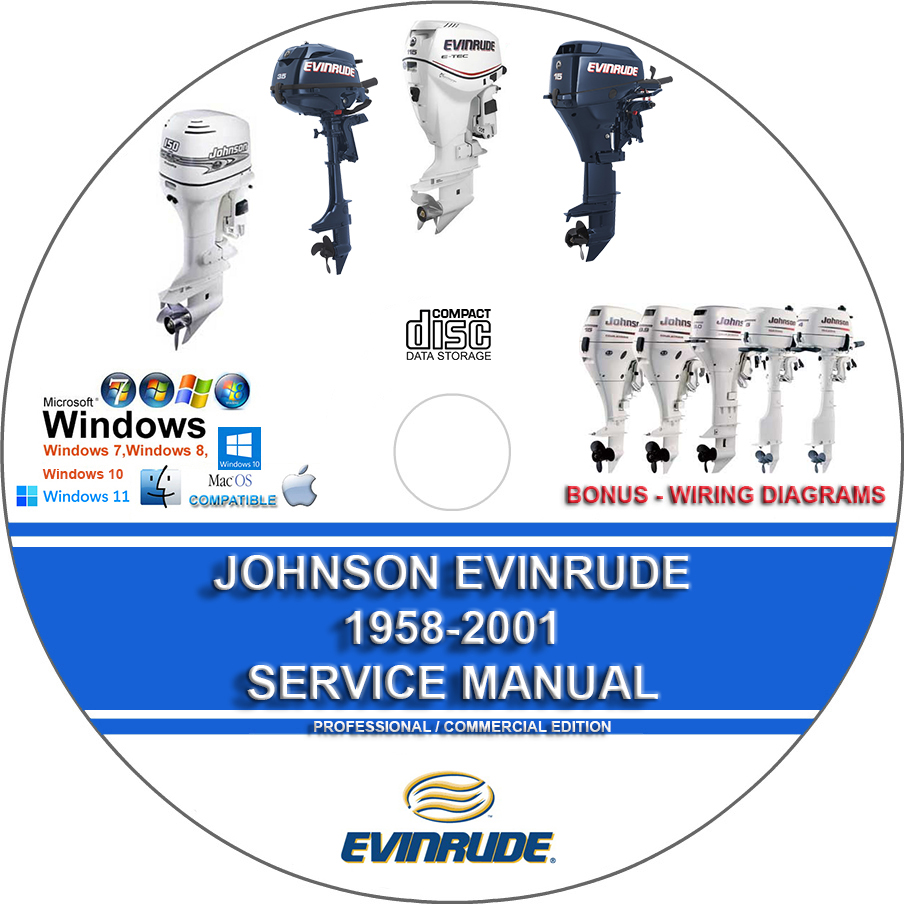
Johnson Evinrude Outboard 1978 1979 1980 1981 1982 1983 1984 1985 1986 1987 1-300 HP Factory Service Repair Manual
Price range: $42.00 through $51.00
Johnson Evinrude Outboard 1978 1979 1980 1981 1982 1983 1984 1985 1986 1987 1-300 HP Factory Service Repair Manual
You can download this or I can ship it to you.
Loaded with Hi Resolution illustrations, instructions, photos, and diagrams, complete to service and repair your JOHNSON EVINRUDE.
Johnson Evinrude Outboard 1978 1979 1980 1981 1982 1983 1984 1985 1986 1987 1-300 HP Factory Service Repair Manual
1958-2001
1.5 – 300 Horsepower
Loaded with illustrations, instructions, photos, and diagrams, complete to service and repair your JOHNSON EVINRUDE.
” Works on any computer, laptop, smartphone, iPad, iPhone, or tablet. “
Years Included:
1958 1959 1960 1961 1962 1963 1964 1965 1966 1967 1968 1969 1970 1971 1972 1973 1974 1975 1976 1977 1978 1979 1980 1981 1982 1983 1984 1985 1986 1987 1988 1989 1990 1991 1992 1993 1994 1995 1996 1997 1998 1999 2000 2001
Includes:
2 & 4 Stroke
1Cyl – 8Cyl
And Jet Drives
All Systems
All Models
Manual Covers:
- General maintenance
- Engine overhaul/Service and repair
- Controls, Final Drive
- Exhaust systems
- Ignition and starting/Charging
- Fuel systems
- Cooling and Lubrication
- Specifications and adjustments
- Transmission overhaul/repair
- Very Detailed Script With Diagrams Specs. & Lots Of Photos. Print Out One Page Or A Whole Reference. All Systems Right Down To The Wire Colors
This manual is the same as the manual used by workshops. Service Manual contains detailed instructions and step by step diagrams for all workshop procedures.
Language: English
Format: PDF – Indexed and Searchable
COMPATIBLE WITH ALL WINDOWS & MAC COMPUTERS
(WINDOWS 11, WINDOWS 10, WINDOWS 8, ETC.)
Windows/Mac/Tablet/Phone Friendly
- Factory Information – Accurate repair procedures, specifications, service information tailored to your vehicle.
- Permanent Ownership – No subscriptions, recurring fees, or expiration dates. Buy it once and keep it forever.
- No Software Required – Works with any standard PDF reader on Windows, Mac, smartphones, and tablets.
- Flexible Storage Options – Save your manual to a USB drive, CD, DVD, cloud storage, Dropbox, computer, or mobile device.
- Print-Friendly Format – Print the entire manual or only the pages needed for a specific repair.
- Portable & Convenient – Compact PDF files make storage and access simple from virtually any device.
- Models: 2, 4, 4.5, 6, 7.5, 9.9, 15, 20, 25, 30, 35 HP.
- Technology: Simple, lightweight twin-cylinder cross-flow designs. Models below 4.5 HP retained integrated or small portable fuel tanks. The 9.9 and 15 HP blocks from this decade became legendary for their performance, featuring a compact layout that remained largely unchanged for twenty years.
- Models: 2-cylinder (40/50/55/60 HP), 3-cylinder (70/75 HP), and 90-degree V4 blocks (85/88/90/115/140 HP).
- Technology: Primarily relied on cross-flow scavenged pistons. However, mid-1980s 70 HP models began receiving advanced “Loop-Charged” induction loops to push better fuel economy. In 1985, OMC launched the budget-friendly “Special” series (like the 88 Special and 48 Special), which stripped out the automatic oiling systems to lower the purchase price.
- Models: 90-degree V6 blocks (150/175/185/200/235 HP) and the massive 3.6L and 4.0L V8 blocks (250/275/300 HP) launched in 1985.
- Technology: The V6 models were the backbone of bass boats and coastal skiffs. The V8 models were pure raw muscle—utilizing external power steering assist lines, pulling fuel through a massive bank of 8 individual carburetors, and requiring dual battery charging setups.
- The INTRODUCES Code System: Launched in 1980, OMC standardized its model year identification using a 10-letter cipher. Check the serial plate on the transom bracket; the last two letters before the model suffix designate the year:
I=1 | N=2 | T=3 | R=4 | O=5 | D=6 | U=7 | C=8 | E=9 | S=0- Examples: TN = 1982 | ED = 1986 | EE = 1989. Models built in 1978 and 1979 do not use this code and must be matched via strict numerical model reference charts.
- Prop-Shaft Horsepower Rating (1985): Prior to 1985, OMC rated horsepower at the engine crankshaft. In 1985, they shifted to industry-standard prop-shaft ratings. This meant a 1985 “90 HP” motor was structurally identical to a 1984 “100 HP” motor.
- First-Generation VRO Pumps (1984–1987): Introduced in 1984, the Variable Ratio Oiling system used crankcase pressure pulses to mechanically mix oil and gas before it hit the carburetors. The early un-primed pumps (1984–1985) lacked robust warning alarms. If the oil line developed an air leak, the pump would continue pumping pure air, leaning out and destroying the powerhead. Upgrading to a modern, four-wire alarmed VRO pump (or converting the motor to a 50:1 premix bypass) is standard practice today.
- CDI Power Pack Failure: This era firmly established solid-state electronic ignitions. The ignition “Power Pack” modules sit on top or on the side of the engine block. They are highly sensitive to heat and voltage spikes. If your motor suddenly loses spark completely on one entire cylinder bank (or drops spark when the engine warms up), the power pack is usually failing.
- Exhaust Housing / Water Tube Grommets: The copper water delivery tube runs up the exhaust housing into the bottom of the powerhead. Over time, the rubber grommet surrounding this tube swells (“water tube grommet grommet-itis”), choking off water flow and causing severe powerhead overheating despite having a brand-new water pump impeller installed.
- Thermostat & Bypass Valving: V4 and V6 blocks from this era use a complex thermostat housing containing plastic pressure-relief bypass valves (called poppet valves). If the engine runs hot only at high speeds, these internal plastic plungers or springs are typically melted, warped, or jammed with sand.
| Medium | USB Flash Drive, DVD, Download |
|---|
Related products
Watercrafts/Boats
Mercury Mercruiser Sterndrive 1964 – 2006 Factory Service Repair Manual
Watercrafts/Boats
Johnson Evinrude
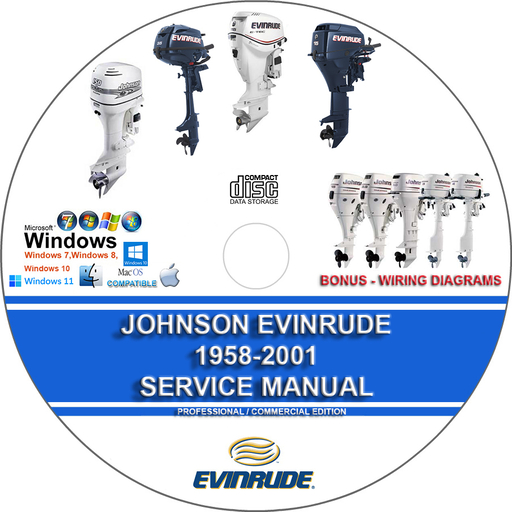
Johnson Evinrude Outboard 1998 1999 2000 2001 1-300 HP Factory Service Repair Manual
Watercrafts/Boats
Watercrafts/Boats
Watercrafts/Boats