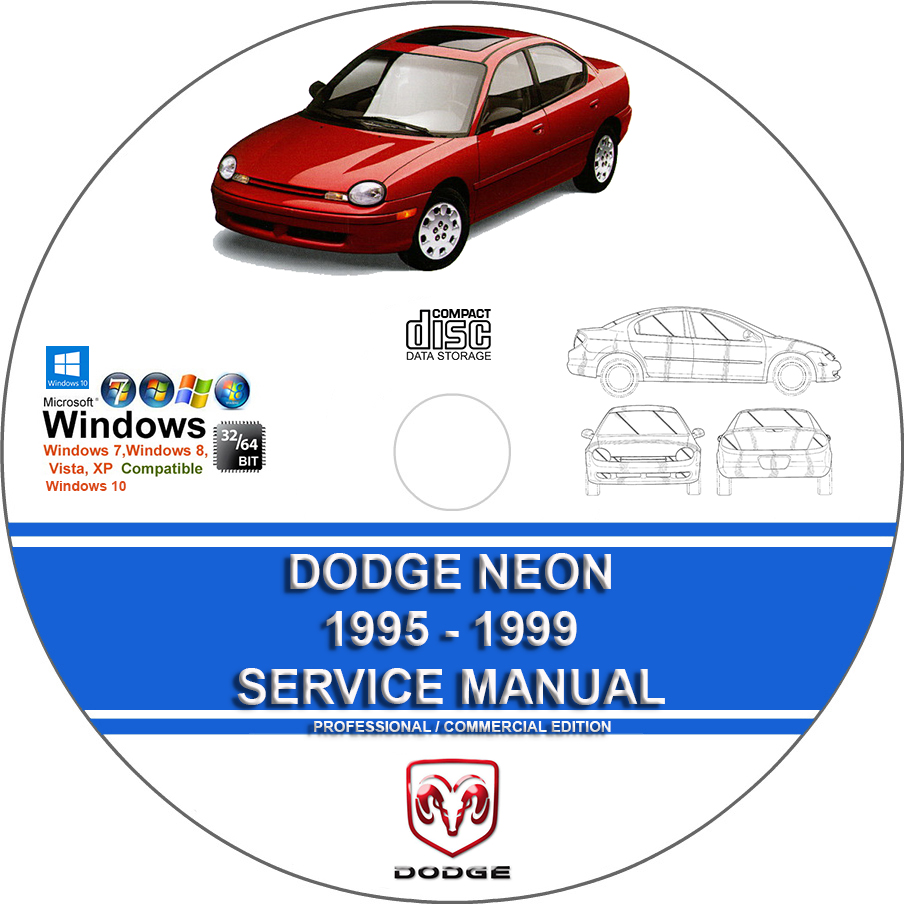
Dodge Neon 1995 1996 1997 1998 1999 Factory Service Repair Manual + Wiring
Price range: $40.00 through $49.00
Dodge Neon 1995 1996 1997 1998 1999 Factory Service Repair Manual + Wiring
You can download this or I can ship it to you.
Loaded with Hi Resolution illustrations, instructions, photos, and diagrams, complete to service and repair your DODGE.
1152 Pages
Dodge Neon 1995 1996 1997 1998 1999 Factory Service Repair Manual + Wiring
Loaded with illustrations, instructions, photos, and diagrams, complete to service and repair your DODGE.
” Works on any computer, laptop, smartphone, iPad, iPhone, or tablet. “
1152 Pages
MODEL YEAR:
1995, 1996, 1997, 1998, 1999
ENGINE COVERS:
- 0L DOHC ENGINE
- 0L SOHC ENGINE
MANUAL COVERS:
- INTRODUCTION
- LUBRICATION AND MAINTENANCE
- SUSPENSION
- DIFFERENTIAL AND DRIVLINE
- BRAKES
- CLUTCH
- COOLING
- BATTERY
- STARTING
- CHARGING SYSTEM
- IGNITION SYSTEM
- INTRUMENT PANEL AND SYSTEM
- AUDIO SYSTEM
- HORN
- VEHICLE SPEED CONTROL SYSTEM
- TURN SIGNAL AND FLASHERS
- WINDSHIELD WIPERS AND WASHERS
- LAMPS
- RESTRAINT SYSTEM
- ELECTRICALLY HEATED SYSTEM
- POWER DOOR LOCKS
- POWER WINDOWS
- POWER MIRRORS
- CHIME WARNING/REMINDER SYSTEM
- WIRING DIAGRAMS
- ENGINES
- EXHAUST SYSTEM AND INTAKE MANIFOLD
- FRAME AND BUMPERS
- FUEL SYSTEM
- STEERING
- TRANSAXLE
- TIRES AND WHEELS
- BODY
- HEATING AND AIR CONDITIONING
- EMISSION CONTROL SYSTEM
This manual is the same as the manual used by workshops. Service Manual contains detailed instructions and step by step diagrams for all workshop procedures.
Language: English
Format: PDF – Indexed and Searchable
COMPATIBLE WITH ALL WINDOWS & MAC COMPUTERS
(WINDOWS 11, WINDOWS 10, WINDOWS 8, ETC.)
Windows/Mac/Tablet/Phone Friendly
- Factory Information – Accurate repair procedures, specifications, service information tailored to your vehicle.
- Permanent Ownership – No subscriptions, recurring fees, or expiration dates. Buy it once and keep it forever.
- No Software Required – Works with any standard PDF reader on Windows, Mac, smartphones, and tablets.
- Flexible Storage Options – Save your manual to a USB drive, CD, DVD, cloud storage, Dropbox, computer, or mobile device.
- Print-Friendly Format – Print the entire manual or only the pages needed for a specific repair.
- Portable & Convenient – Compact PDF files make storage and access simple from virtually any device.
- Dodge vs. Plymouth: The two cars were nearly identical badge-engineered twins. The primary differences were the front bumper designs, wheel covers, emblem colors, and specific trim package names (like the Dodge Sport vs. Plymouth Expresso).
- Coupe: A sleek 2-door version launched for the 1995 model year. It featured unique frameless door glass that gave it a sporty look.
- Sedan: A traditional 4-door body style built with an aggressive “cab-forward” design. This design pushed the wheels to the corners to maximize passenger legroom.
- 1995 (Launch): The Neon debuted with immense popularity. Early models were praised for quick acceleration but suffered from loud cabin noise and poor paint quality.
- 1996: Dodge upgraded the engine computers and fixed early mechanical bugs. Frameless windows on the coupe were adjusted to reduce highway wind noise.
- 1997: A rugged, racing-inspired Neon ACR (Competition Package) became more widely available to the public. It featured upgraded suspension, a close-ratio manual transmission, and no air conditioning to save weight.
- 1998: A updated dashboard design fixed early squeak and rattle issues. The premium R/T (Road/Track) performance package debuted with racing stripes and a stiffer suspension.
- 1999: This was the final production year for the first-generation design. Production wrapped up early to prepare assembly lines for the completely redesigned, larger year-2000 second-generation Neon.
- 2.0L SOHC 4-Cylinder: The standard Single Overhead Cam engine. It produced 132 horsepower, which was vastly more powerful than standard Honda Civics or Toyota Corollas of the same era.
- 2.0L DOHC 4-Cylinder: The optional Dual Overhead Cam “High Output” engine. It bumped power to 150 horsepower and was standard on the Sport coupe, R/T, and ACR models.
- 5-Speed Manual: A crisp transmission built by New Venture Gear that made the lightweight car highly popular in grassroots autocross racing.
- 3-Speed Automatic: A simple Torqueflite automatic transmission that provided reliable commuting but hurt highway fuel economy due to the lack of an overdrive gear.
| Medium | USB Flash Drive, DVD, Download |
|---|
Related products